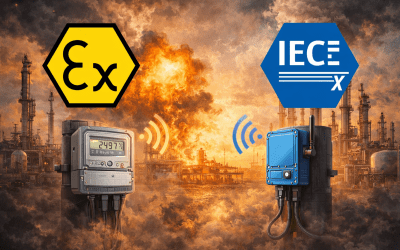
IoT sensor design for safe, scalable connectivity in hazardous environments
In the push for industrial digitalisation (i.e., going beyond ‘optimising’ processes and tasks to enable faster, more effective decisions based on real-time data), wireless sensors have become the eyes and ears of modern infrastructure. These sensors do most of the heavy lifting by capturing the data needed to enable predictive maintenance, remote monitoring, and real-time safety for both workers and the environment. But when it comes to ATEX wireless sensor design in hazardous environments, assumptions that hold true in other sectors, such as consumer goods or healthcare, are subject to fundamental constraints.
The same device enclosure that prevents ignition (such as a flameproof cast-aluminium housing) also acts as a shield, preventing or stifling one of the device’s core functions: reliable wireless data transmission. When you add strict energy limits, restricted maintenance access, and long operational lifespans, the design challenge shifts from a question of simple connectivity to one of system viability.
For engineers, it’s a technical hurdle and a brutal physics problem: how do you get a high-frequency radio signal out of a sealed enclosure designed to contain an explosion? For product teams, it’s a commercial crossroads: which early decisions on materials, battery chemistry, and antenna architecture determine whether a product scales globally or fails in certification?
And in hazardous environments, failure isn’t theoretical. Incidents such as the Texas City Refinery Explosion demonstrate how small oversights in equipment design can escalate into catastrophic outcomes, and further reinforce why safety-led engineering – especially in the energy sector -must come first.
The Faraday Cage problem in ATEX wireless sensor design
The traditional approach to explosion protection, flameproof enclosures (Ex d), relies on containing any internal ignition within a robust housing, typically made from cast aluminium or stainless steel, and venting the resulting pressure through precisely machined flame paths. These joints are precisely engineered to cool escaping gases below the ignition point of the surrounding atmosphere before they reach the outside world.
While effective for commonly used industrial components that create sparks or heat (e.g., motors or transformers), these enclosures introduce a critical limitation for wireless systems. Electromagnetically, they behave as Faraday cages, attenuating radio signals to the point where a connected device may become functionally silent.
This creates a fundamental design conflict: the enclosure must be sealed for safety but also allow the signal to escape for connectivity. In practice, this often pushes designs away from purely Ex d approaches toward more nuanced, material-led strategies such as RF-transparent polymers or complex antenna interfaces.
However, these solutions introduce their own constraints. An enclosure material that allows a 2.4GHz signal to pass must also survive the industrial reality of UV degradation on a desert rig, salt-saturated fog, and the mechanical impacts of heavy-duty maintenance.
When connectivity is no longer a given, it becomes a structural component. In high-stakes environments, the radio signal shouldn’t just “escape” the box; it must be engineered to do so without compromising the physical integrity of the flame path.
Intrinsic Safety (Ex i) and IoT power constraints in hazardous environments
For many modern IoT applications, Intrinsic Safety (Ex i) offers a more flexible alternative to flameproof enclosures. Rather than containing explosions, it prevents them by ensuring that electrical and thermal energy levels remain below ignition thresholds, even under defined fault conditions.
In theory, this enables smaller, lighter, and more deployable wireless sensors. But in practice, it introduces strict energy constraints that directly impact connectivity. Wireless communication is inherently power-intensive. During transmission bursts, cellular or LoRaWAN modules can draw significant peak current, far exceeding their average consumption. To comply with ATEX requirements, these peaks must be carefully controlled using energy-limiting circuits:
- Zener barriers
- Current-limiting resistors
- Fast-acting fuses
These are not add-ons. They must be designed into the PCB design architecture from the earliest stages. If the power system cannot clamp transient energy spikes without destabilising the radio module, the device will struggle to pass certification and may fail unpredictably in the field.
Thermal management and T-ratings in ATEX sensor enclosures
Thermal behaviour is one of the most underestimated challenges in the design of ATEX wireless sensors. To prevent ignition risks and protect internal electronics, devices are often potted or encapsulated using silicone or epoxy resins. While this improves mechanical integrity and environmental protection, it significantly restricts heat dissipation.
In hazardous environments, every device must comply with a defined Temperature Class (T-Rating). This is a safety classification for equipment in hazardous or explosive environments that defines the maximum surface temperature a device can reach and ensures it never exceeds a specified threshold (for example, 200°C for T3 or 85°C for T6), thereby creating an additional constraint.
Even a single high-power component, such as a voltage regulator or microprocessor, can generate a localised hot spot. And because potting compounds act as thermal insulators, heat cannot dissipate through airflow. Instead, thermal management must be designed into the PCB itself:
- Using copper planes to spread heat
- Minimising localised thermal concentration.
- Carefully selecting components based on efficiency, not just performance.
The result is a design process in which thermal behaviour must be predicted and controlled well before certification testing begins.
Battery design for ATEX wireless sensors: ‘Sealed for Life’ constraints
Maintenance assumptions that apply to conventional IoT devices do not hold in hazardous environments. Accessing a device in a Zone 1 or Zone 2 area may require a Hot Work Permit, operational downtime, or specialised personnel. In many cases, routine battery replacement is not commercially viable.
This leads to a ‘sealed for life’ design requirement (often Ingress Protection ratings such as IP66/67/68) where sensors must operate autonomously for often a decade or more, making battery selection a crucial architectural decision. Lithium Thionyl Chloride (LiSOCl₂) chemistries are commonly used due to their high energy density, low self-discharge, low-power communication, and long operational lifespan. However, they introduce their own challenges.
These batteries exhibit high internal resistance and can undergo passivation during extended low-power operation. When the device attempts to transmit, the required current spike may not be delivered reliably. To address this, engineers must design pulse-handling strategies into the hardware, ensuring that the system can wake, transmit, and recover without triggering battery limitations.
This is not something that can be solved by firmware alone; it must also be addressed at the schematic and system architecture levels.
Wireless connectivity trade-offs in hazardous industrial environments
Even when enclosure, power, and thermal constraints are addressed, maintaining reliable connectivity in real-world environments remains a challenge.
Industrial sites are inherently hostile to wireless communication due to factors such as dense metal infrastructure, electromagnetic interference, and physical obstructions and reflections. Therefore, protocol selection (LoRaWAN, NB-IoT, or Bluetooth) must align with power availability, range requirements, and environmental conditions.
Performance in controlled testing environments rarely translates directly to field conditions, so ATEX wireless sensor design must also account for degraded signal propagation, intermittent connectivity, and network resilience from the outset.
ATEX vs IECEx implications for energy IoT device certification
While the engineering challenges are significant, they are closely tied to commercial or custom outcomes. Design decisions made early in development directly affect whether an IoT energy device certification can achieve ATEX approval for the European market or IECEx approval for global deployment. Misalignment between product design and certification requirements often leads to failed compliance testing, costly redesign cycles, and delayed market entry.
In contrast, aligning engineering decisions with certification pathways from the outset enables smoother approval processes and faster deployment or commercialisation.
Designing ATEX wireless sensors for certification and deployment
A common failure mode in product development is treating ATEX as a downstream requirement, as in something to be addressed after the core design is complete. In reality, certification is not an add-on but a design constraint that shapes the entire system. Successful products approach this by:
- Developing enclosure design, RF strategy, and power architecture together.
- Informing early design decisions according to certification requirements.
- Resolving trade-offs at the system level, not retrofitting solutions later.
While these constraints are significant, they are not prohibitive. Established design patterns, certified components, and proven architectures enable the reliable development of wireless systems when considered from the outset.
Strategic takeaway: The system architecture for ATEX wireless sensor design
The commercial risk in the energy sector is not failing to innovate, it’s failing to certify. When ATEX wireless sensor design is treated as a late-stage consideration, the result is often a costly cycle of redesign, testing, and delay.
The most effective approach is to treat compliance as a core part of system architecture, because in hazardous environments, success is not defined by whether a sensor can transmit data under ideal conditions: it’s defined by whether it can do so safely, reliably, and at scale within the constraints of the real world where it will ultimately operate.
Partner with Ignitec: Fully bespoke from concept to certified asset
Navigating the intersection of high-performance wireless tech and rigid safety standards requires a multidisciplinary approach that many internal teams aren’t equipped to handle. At Ignitec, we provide the technical backbone and regulatory foresight needed to turn complex energy IoT concepts into tested, certified, market-ready hardware.
Whether you’re struggling with signal attenuation in rugged enclosures or optimising power budgets for intrinsic safety, we help you bridge the gap between a prototype that works in the lab and a risk-mitigated product that’s safe in the field. Schedule a free discovery call with an expert on our team to learn more.