Ensuring safety in product design for explosive environments
The ‘move fast, break things’ tech philosophy popularised by Mark Zuckerberg refers to prioritising rapid deployment, iteration, and risk-taking over perfection and stability. But when those ‘things’ are hundreds of devices scattered across the globe, sending a team out to fix them is impractical and expensive. Worse still, is if those devices are deployed to a hydrogen plant, offshore rig, or chemical refinery – where the air itself is fuel. In these high-stakes environments, a single faulty spark from a poorly shielded sensor represents a catastrophic ignition risk. Compliance regulations, such as ATEX vs IECEx, exist to mitigate this danger, ensure worker safety, and enhance operational reliability in hazardous environments.
For product teams, compliance isn’t a checkbox. It’s a design constraint that defines the boundary between safe operation and unacceptable risk. The transition from a laboratory prototype to a certified energy asset isn’t linear and requires ongoing negotiation between modern connectivity and 21st-century legacy safety frameworks designed for a very different technological era.
IoT devices requiring certification
In hazardous environments, certification is not just for large industrial machinery. Any electronic device capable of generating heat, sparks, or stored electrical energy is a potential liability. This includes many of the connected systems now being deployed across energy infrastructure, such as environmental sensors, asset tracking devices, communication gateways, and surveillance systems.
The paradox is that as these devices become smaller and more powerful, their potential risk profile actually increases. Therefore, in zones where flammable gases, vapours, or combustible dust may be present, these devices must be proven safe by design and cannot be retrofitted. This is typically achieved through Intrinsic Safety (Ex i): a design approach that limits a device’s energy to a level that physically prevents ignition, even under fault conditions where hardware fails.
The industries where this matters most are those in which explosive atmospheres are part of normal operation: oil and gas, chemical and petrochemical processing, industrial refining, mining, and, increasingly, facilities producing and storing hydrogen. And it’s precisely because the stakes are high that even for the smallest sensor, the distinction between ATEX and IECEx becomes one of the most important strategic decisions that product teams make.
ATEX vs IECEx
The primary friction for any specialised electronic product, such as IoT for explosive environments, isn’t technical capability, but the fragmented nature of safety standards. While the objective is universal, i.e., to prevent a spark or heat source from meeting a flammable atmosphere, the legal pathways diverge.
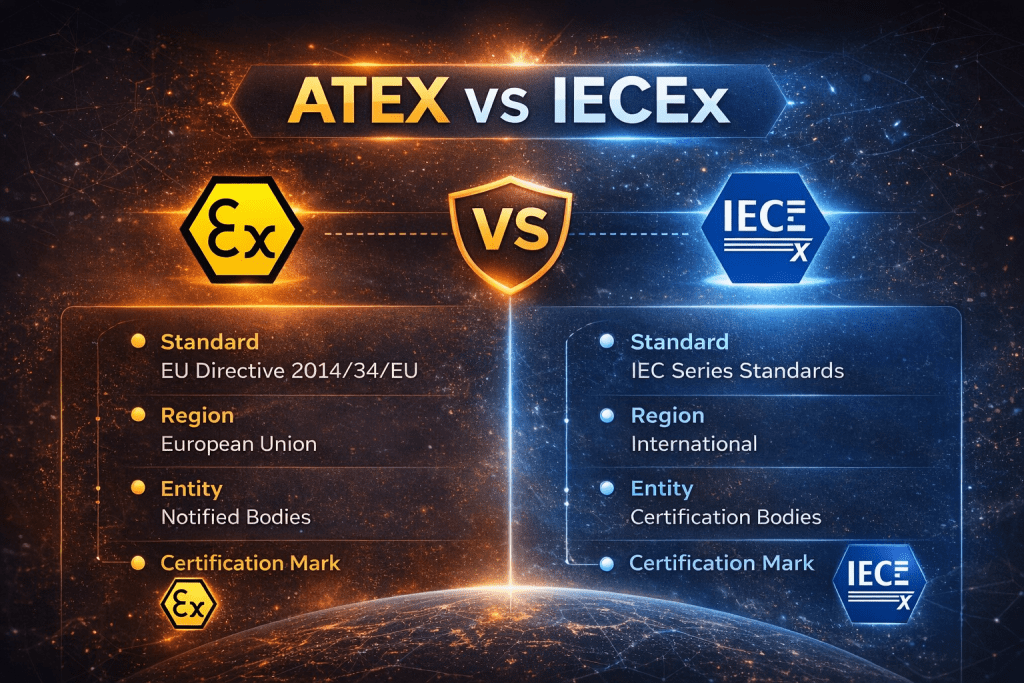
ATEX Vs IECEx Certification
ATEX (Atmosphères Explosibles) remains the non-negotiable “license to operate” across the European Union, while UKEX is now the UK equivalent framework following Brexit. Both are legal regimes that place equal emphasis on product design and the operational safety of the end-user environment.
ATEX requires CE marking, whereas UKEX requires UKCA marking, alongside the Ex symbol and certification by approved bodies.
IECEx, governed by the International Electrotechnical Commission, functions as a “Global Passport.” It is widely recognised across markets in Australia, the Middle East, and much of Asia, and is often treated as the international benchmark for hazardous-area certification, focusing on technical compliance. IECEx-certified products focus on the Certificate of Conformity and technical marking, requiring strict third-party audits.
While both systems rely on the same IEC 60079 series of standards (norms governing the design, testing, and installation of electrical equipment in hazardous areas), and therefore offer similar levels of safety, the documentation requirements differ. The strategic error many teams make is treating these pathways as interchangeable. While an IECEx certificate can streamline aspects of ATEX approval, the reverse is rarely true. The implication is structural: certification strategy is not a regulatory decision between ATEX vs IECEx. It’s a market-access decision that shapes how, where, and how quickly your product can scale.
In practice, successful product teams design for both: embedding a dual-track certification strategy not at the point of testing, but at the very first architectural sketch.
Overcoming the Faraday Cage: Wireless IoT in hazardous zones
A fundamental constraint sits at the heart of Energy IoT devices. The ‘Explosion-Proof’ (Ex d) enclosures required to contain internal ignition events are typically constructed from thick-walled cast aluminium or stainless steel. In electromagnetic terms, they are highly effective Faraday cages (conductive enclosures that block external static and non-static electric fields, such as electromagnetic radiation).
For a device designed to transmit data via LoRaWAN, NB-IoT, or Bluetooth, this creates a direct conflict. The very enclosure that ensures safety also suppresses signal propagation, which is imperative for smart devices in hazardous areas such as:
- Gas detectors that continuously monitor combustible gases and volatile organic compounds (VOCs) and provide alerts when dangerous thresholds are reached. Connected via IoT, these devices can send real-time data to control rooms or mobile devices.
- Wearable safety (e.g., connected watches or belts) for workers in hazardous environments which monitor their location, vitals, and surrounding environmental conditions, allowing for immediate response in case of emergencies.
- Connected equipment with built-in smart components that monitor operational status and alert operators to any faults or predictive maintenance requirements, helping to prevent incidents.
Resolving this is not a matter of ruggedising an antenna. It requires deliberate integration of RF-transparent materials, specialised couplers, and careful consideration of antenna placement within the industrial design. Signal integrity becomes inseparable from safety compliance.
If connectivity cannot be reliably maintained in situ, the product risks failing in its core purpose – regardless of whether it passes certification. Solving the signal-to-safety ratio is therefore not just a technical hurdle, but a defining factor in whether a connected device can operate meaningfully in the field.
Energy budgeting for Intrinsic Safety: The power constraint
To achieve Intrinsic Safety (Ex i), a device must strictly limit its own electrical and thermal output. In modern IoT systems, where edge processing, sensing, and wireless communication are expected, this creates a tightly constrained energy budget in which every milliwatt counts. It dictates how frequently a device can transmit, how much processing can occur at the edge, and ultimately how long the system can operate autonomously.
This marks a departure from conventional IoT optimisation, which prioritises speed, bandwidth, and responsiveness. In hazardous environments, those priorities are secondary to controlled energy behaviour.
This is where advances in low-power silicon and TinyML shift from technical innovation to commercial necessity. The ability to perform meaningful computation within a capped energy envelope enables teams to preserve device functionality without breaching safety thresholds, potentially transforming a regulatory constraint into a competitive differentiator.
Designing IoT in hazardous zones for longevity
In most IoT deployments, maintenance is routine. In a refinery, underground mine, or offshore installation, it is anything but. Opening an enclosure to replace a battery or connect a device for a firmware update may require a ‘Hot Work Permit’( a formal safety document authorising high-risk activities) or even a partial shutdown of operations.
This fundamentally changes the product’s design philosophy. The battery is no longer a consumable component but part of the device’s structural and safety architecture. Designing for five to ten years of autonomous operation demands not only stable chemistries, such as lithium thionyl chloride, but also firmware that treats every microampere as a finite and valuable resource. Power consumption, communication frequency, and system uptime must all be engineered with long-term operational constraints in mind.
The implications extend beyond engineering. Longevity affects maintenance strategies, service models, and total cost of ownership. In hazardous environments, reducing the need for human intervention is both cost and safety-efficient, and also directly reduces operational risk.
The commercial cost of delayed certification
Treating IoT product certification as a ‘downstream activity’ (i.e., something you can handle at the end of a development cycle) is risky for any industry, yet it remains a common approach in contexts such as consumer electronics or prototype-heavy startups. However, in the energy and industrial sectors, it’s a recipe for disaster. Teams thinking that the ATEX vs IECEx decision can be determined at a later stage often enter a redesign loop ( a cycle of testing, failure, and structural modification) that can delay product launch and deployment for up to a year.
In fast-moving energy markets where timing is everything, delay is rarely recoverable. Market windows close, competitors advance, and investor confidence erodes.
ATEX vs IECEx is a product strategy decision – not a compliance exercise
ATEX vs IECEx are often framed as regulatory choices and obligations – and they are. But in practice, they exert influence far earlier in the product development cycle – shaping architectural decisions, constraining design choices, and defining the boundaries of what a device can and cannot do. ATEX and IECEx certification determines not only whether a product can be sold, but where, how quickly, and at what scale.
At Ignitec, product development for hazardous environments is approached as a unified challenge, where RF performance, power management, certification strategy, and long-term operability are considered together from day one. This means designing systems that do more than meet regulatory thresholds: function reliably in signal-restricted enclosures, operate within strict energy limits, endure in environments where maintenance is costly and constrained – and most importantly, keep people safe.