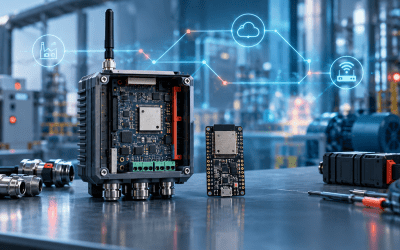
Predictive maintenance IoT sensors have moved from pilot projects to procurement line items across manufacturing, energy and logistics operations. Where a maintenance team once relied on fixed service intervals or a technician to notice that ‘something doesn’t sound right’, sensor networks now stream vibration, temperature, current and acoustic data around the clock. Increasingly, machines can interpret that data themselves and signal anomalies before an engineer ever opens a dashboard.
This post is the sixth in Ignitec’s Industrial IoT and Automation series, and the first to bring artificial intelligence into the conversation directly: everything the series has covered so far, from low-power radio links to hardened gateways, exists to get sensor data somewhere a model can act on it.
What does predictive maintenance for IoT sensors change on the ground level?
Maintenance can be reactive, preventative, or predictive. While the first two either wait for something to break down first or replace parts on a fixed schedule – whether or not it’s needed – predictive maintenance is proactive. Sometimes called condition-based maintenance, it uses live sensor data to service equipment only when its actual condition warrants it. The distinction sounds administrative, but the economics behind it are substantial.
Research collated across steel, chemical and power generation facilities found predictive maintenance programmes cutting unplanned downtime by up to 50% and reducing overall maintenance costs by 18 to 25%, with per-facility savings reported from the low hundreds of thousands to several million pounds depending on scale (IIoT World).
|
🛠️ Design Consideration: Sensor sample rates for bearing fault detection typically need to reach into the tens of kilohertz to capture the high-frequency signatures of early-stage defects. A gateway budgeted for simple temperature logging at 1 Hz will not cope with triaxial vibration streaming at 20 kHz per axis. Size the edge compute and storage budget around the sensor with the highest bandwidth requirement, not the average across the deployment. |
The sensor layer: What predictive maintenance IoT sensors measure
Four predictive maintenance IoT sensor categories account for most deployments:
- Vibration sensors: Typically MEMS or piezoelectric accelerometers that capture the frequency signatures associated with imbalance, misalignment, bearing wear and looseness.
- Thermal sensors: From simple thermocouples to fixed thermal imaging cameras that flag localised heating caused by friction, poor lubrication or electrical faults.
- Acoustic and ultrasonic sensors: These pick up high-frequency emissions from early-stage bearing defects and compressed air or steam leaks before they become audible to the human ear.
- Current and electrical signature sensors: Analyse motor current draw to detect rotor bar damage, winding faults and load imbalance without any additional hardware fitted to the machine itself.
MEMS accelerometers have become the default choice for retrofits because they are cheap and low-power enough to run for years on a coin cell. One study built around an ESP32 microcontroller and a MEMS accelerometer processed vibration and acoustic signals using standard RMS and FFT techniques. It reached over 73% fault detection accuracy for imbalance and wear conditions, using hardware costing a fraction of an industrial piezoelectric sensor package (PMC). It is the same class of microcontroller covered under ESP32 Industrial Gateways earlier in this series, now doing double duty as both a protocol bridge and a sensor front end.
From signal to decision: Where AI and machine learning come into play
Raw vibration and real-time data mean little without something to interpret it. This is where predictive maintenance departs from the rest of the series so far: the previous posts in this series centred around getting data reliably and securely from a sensor to a system. This post is the first to ask what happens once the data arrives, and the answer, increasingly, is a machine learning model running at the edge.
Two approaches are most commonly used across modern industrial automation sites:
Anomaly detection models learn what normal looks like for a specific machine (typically from weeks of baseline vibration, temperature and current data), then flag deviations without needing labelled failure examples. This suits assets where failure data is scarce, which applies to most industrial equipment, since machines that fail often enough to generate a useful labelled dataset tend not to stay in service long.
Classification and remaining-useful-life models go further, using algorithms such as random forests, support vector machines or gradient-boosted trees trained on historical failure data to estimate not just whether a fault exists but how it is likely to progress. One widely cited industrial study compared five machine learning models, including k-nearest neighbour, random forest and naive Bayes classifiers, against vibration, current and temperature data from electrical motors for anomaly detection and failure prediction.
Where the inference runs is just as important as which model runs it. Cloud-based inference offers more compute and easier retraining but adds latency and depends on a live connection. Edge inference on the gateway itself, using frameworks such as TensorFlow Lite for Microcontrollers, returns a decision in milliseconds and keeps working through a network outage, at the cost of a much smaller model and a more constrained toolchain. For a time-sensitive fault such as an imminent bearing seizure, that latency difference is the entire reason to run inference at the edge rather than the cloud.
|
⚠️ Critical Alert A predictive maintenance IoT sensor model is only as reliable as the baseline period it was trained on. Programme sponsors should budget for a data collection phase of several weeks to months before any model goes live, and expect a tuning period to bring false positive rates down to a level maintenance teams will actually trust. |
System architecture: Getting sensor data to the model
None of this works without the groundwork already covered in this series. Sensor data still needs a low-power radio link to reach a gateway, which is where WiFi HaLow’s longer range and lower power draw earn their place in dense sensor deployments. That gateway still needs the deterministic performance and thermal design discussed under Industrial Gateway Design, and increasingly it is the same ESP32 Industrial Gateways covered earlier in this series that now carry the edge inference workload alongside their existing protocol translation duties.
Once a sensor reading turns into a maintenance alert, it typically still travels over MQTT, the lightweight publish-subscribe protocol underpinning every architecture in this series so far, whether the destination is a maintenance dashboard, a CMMS work order queue or a cloud model used for further analysis.
Predictive maintenance does not replace this stack. It adds a decision-making layer on top of it, usually running as a lightweight inference engine on the gateway itself, with the option to forward flagged events, rather than every raw reading, to the cloud for deeper analysis or model retraining.
|
🛠️ Design Consideration Running inference on the same gateway that handles protocol translation and security functions competes for the same limited RAM and flash. Profile the memory footprint of the trained model, quantised where possible, against the gateway’s existing workload before committing to a single-board design. A model that fits in isolation testing may not fit once TLS session buffers, an MQTT client and a device management agent are also resident. |
Relevant ISO Standards that keep predictive maintenance IoT sensor data meaningful
Sensor data is only useful if it is interpreted consistently, and two ISO standards do most of the work here. ISO 17359 sets out the general procedure for building a condition monitoring programme, from the initial machine audit through to setting alarm thresholds and closing the loop once a fault is corrected. It does not prescribe specific vibration limits, but it gives engineering teams a common structure for deciding what to measure, how often, and what to do when a reading crosses a threshold.
ISO 20816 fills in the numbers for vibration specifically, establishing the measurement conditions and evaluation zones, from acceptable to requiring immediate shutdown, used to judge whether a given vibration reading is a concern (ISO 20816-1). Referencing both standards in a predictive maintenance specification gives a shared vocabulary between the engineering team deploying the sensors and the maintenance team acting on the alerts, which matters more than any single sensor’s accuracy figure once a programme scales past a handful of machines.
IoT sensor data security for predictive maintenance systems is not optional
Predictive maintenance IoT sensors and gateways sit on the same operational technology network covered under IEC 62443 earlier in this series, and the security implications do not shrink because the payload is a vibration reading rather than a control command. An attacker able to spoof or suppress sensor data on a predictive maintenance network can mask a genuine fault, or trigger unnecessary maintenance actions that themselves become a form of denial of service against a production line.
The zone and conduit model, device hardening and secure firmware update practices already established for gateways in this series apply without modification to predictive maintenance deployments; adding an inference workload does not create an exemption.
|
⚠️ Critical Alert Where a predictive maintenance system is permitted to trigger an automated shutdown or a work order without human review, it has effectively become a safety-adjacent control system, and should be assessed and secured to that standard rather than treated as a monitoring convenience |
.Real-world deployments of predictive maintenance IoT sensor systems
A University of Sheffield project under the Pitch-In programme retrofitted a legacy manufacturing facility with an IoT-based predictive maintenance system, moving process control from three manual inspections a day to continuous remote monitoring. The change improved inspection quality and reduced maintenance labour costs, and it did so on infrastructure that predates any of the wireless standards covered in this series. This illustrates that predictive maintenance is as much a retrofit opportunity as a greenfield design decision.
At the sensor end, ABB’s smart sensor for mounted bearings analyses vibration and temperature data directly on the bearing housing to flag early signs of wear, since roughly 80% of bearing failures trace back to inadequate lubrication and show up as a detectable change in running temperature before they show up as audible noise. The sensor communicates wirelessly to a handheld device or gateway, extending condition monitoring to bearings in locations that are inconvenient or unsafe for a technician to inspect manually and regularly.
The business case for decision makers
For a programme sponsor or finance stakeholder, the numbers that matter are downtime avoided and cost per intervention, not model accuracy in isolation. McKinsey has reported an 18 to 25% reduction in maintenance costs from one company’s analytics-driven maintenance programme, measured against its own historical data.
Downtime reductions of up to 50% are widely cited across industry sources as a general benchmark for predictive maintenance, though that particular figure is harder to trace to a single primary study and is best treated as an indicative range rather than a guaranteed outcome. Case studies from steel manufacturing, chemical processing and power generation report per-facility first-year savings ranging from the low hundreds of thousands to several million dollars, with results varying by asset criticality and the number of machines covered.
These figures come with a caveat that matters more than any headline number: reported savings tend to come from single, well-chosen case studies rather than fleet-wide averages, and return on investment tracks asset criticality closely. Sensor deployment should follow the same prioritisation logic as any other capital allocation, starting with the machines whose failure carries the highest production or safety cost, rather than the machines that happen to be easiest to instrument.
|
🛠️ Design Consideration Build the business case around avoidable downtime hours on named critical assets rather than a blanket sensor rollout. A pilot on the two or three machines with the highest unplanned downtime cost produces a more defensible case for wider rollout than an even spread of sensors across a whole production line. |
Common pitfalls in predictive maintenance IoT sensor programmes
A handful of pitfalls recur across predictive maintenance programmes regardless of sector:
- Skipping the baseline period and going live with alarm thresholds borrowed from a different machine or a vendor default, which produces false alerts until the model has seen enough of the specific asset’s normal behaviour.
- Treating the maintenance team as an afterthought, so alerts arrive in a format or system nobody checks, and the sensor investment sits unused alongside a CMMS that was never integrated.
- Under-specifying network security on the assumption that sensor data is low-value, then discovering that the same gateway also carries safety-relevant control traffic.
- Instrumenting easy-to-reach assets instead of critical ones, because sensor placement followed convenience rather than the criticality ranking that should have driven the rollout.
Final Thoughts
Predictive maintenance IoT sensor systems draw on nearly everything this series has covered so far: the radio links, the gateway hardware, the messaging protocol and the security model. It is also where those individual pieces stop being separate engineering decisions and start behaving as a single system with a shared purpose, which is exactly the territory the closing post in this series will cover, drawing the whole Industrial IoT and Automation stack together into a single reference architecture.